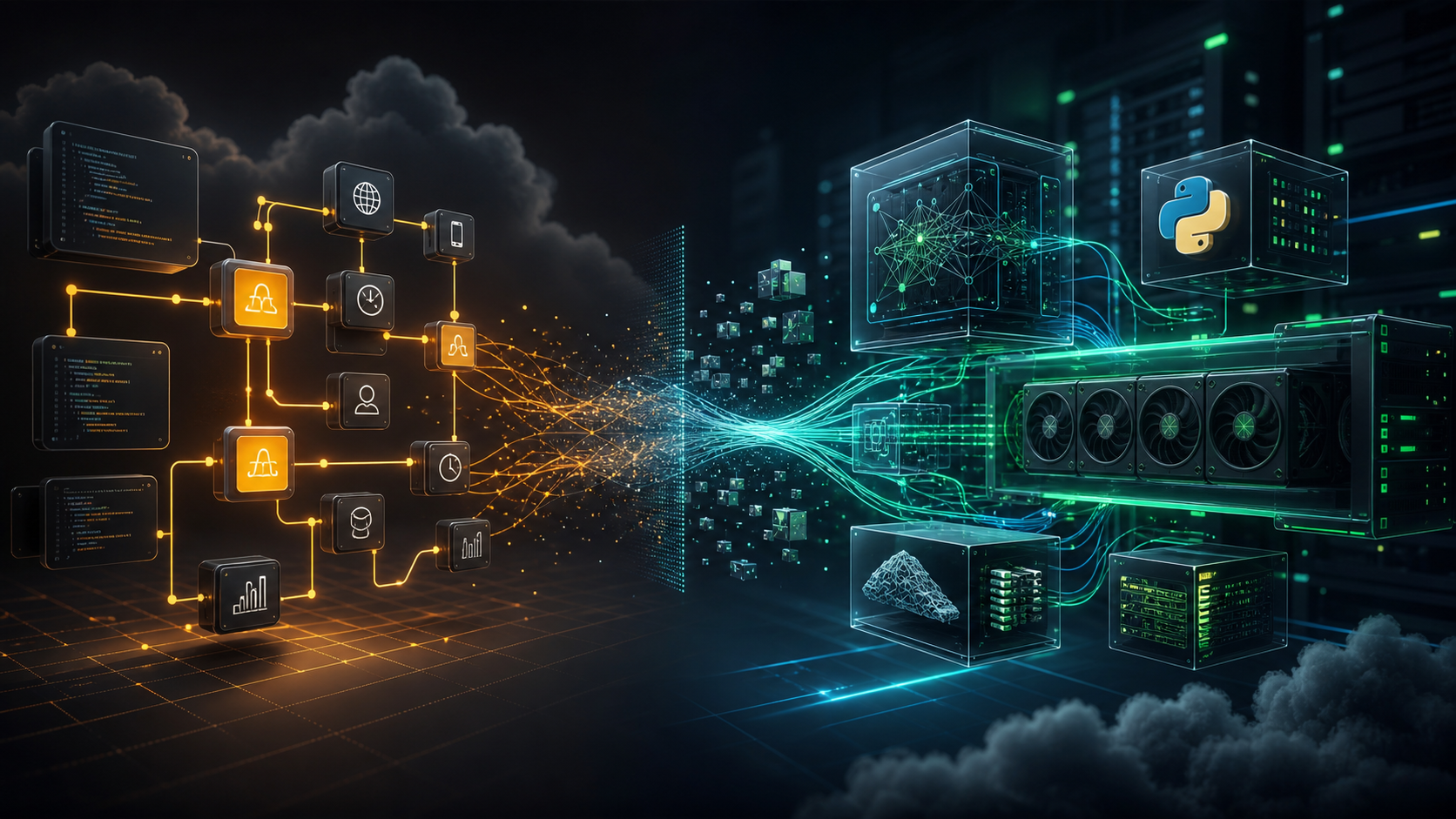
Short answer: AWS Lambda is excellent for ordinary serverless application logic, event handlers, API glue, and lightweight automation. Modal is the better fit when the workload is AI-shaped: GPUs, model weights, Python inference stacks, long batch jobs, queues, sandboxes, and scale-to-zero AI compute.
Ready to build on Modal? See Build on Modal with Nythral for a practical service page with GPU, queue, endpoint, and backend integration scope.
Modal often gets described as “AWS Lambda for AI.” That phrase is directionally useful, but technically incomplete. Both services let developers run code without managing servers, and both can bill based on actual execution time. But they are designed around different workload assumptions.
AWS Lambda is a mature event-driven serverless compute service. It is excellent for API handlers, background glue, S3 events, queue consumers, scheduled tasks, lightweight transformations, and orchestration around AWS systems. Modal is a serverless compute platform designed around AI and data workloads: Python functions, GPUs, custom images, model weights, web endpoints, queues, Volumes, Secrets, schedules, and Sandboxes.
Modal vs AWS Lambda At A Glance
| Decision point | Modal | AWS Lambda |
|---|---|---|
| Best mental model | Serverless AI/data runtime for Python functions and GPU jobs. | General-purpose event-driven serverless functions inside AWS. |
| GPU support | First-class GPU selection for AI workloads. | No native Lambda GPU option for function execution. |
| Timeout | Designed for heavier AI jobs with configurable timeouts. | Maximum function timeout is 900 seconds. |
| Memory | CPU, GPU, memory, and image configuration are workload-shaped. | Memory can be configured up to 10,240 MB. |
| Container images | Modal Images, Dockerfiles, and existing container images. | Container image functions up to 10 GB image size. |
| Best use case | Inference, embeddings, model jobs, AI batch work, sandboxes, GPU workflows. | APIs, events, automation, AWS integration, lightweight compute, orchestration. |
Where Lambda Is Strong
Lambda is a very strong tool when the workload is small, event-driven, and close to AWS services. A user uploads a file to S3, Lambda validates metadata. A Stripe webhook arrives, Lambda records an event. A queue message appears, Lambda updates a status row. An API Gateway request needs lightweight business logic. A scheduled job cleans old records. These are exactly the kinds of jobs Lambda was built to handle.
The AWS ecosystem is also the advantage. Lambda connects naturally to API Gateway, EventBridge, SQS, SNS, DynamoDB, S3, Step Functions, CloudWatch, IAM, and VPC networking. If the workload lives inside AWS and does not need GPU acceleration or heavy model runtime behavior, Lambda is often the boring correct answer.
Where Lambda Starts To Struggle For AI
AI workloads are often heavy in ways Lambda is not optimized to absorb. Model weights can be large. GPU acceleration may be required. Python dependencies can be large. Cold starts can matter. Inference servers may want long-lived workers. Batch jobs may run longer than 15 minutes. Fine-tuning, image generation, video generation, transcription, embeddings, and agent sandboxes all push beyond the shape of a normal web function.
Lambda supports container images, increased ephemeral storage, and up to 15 minutes of execution time, so it can handle some AI-adjacent work. But the lack of native GPU execution is the core limitation. Once the job needs GPU inference or serious model serving, the architecture usually shifts toward SageMaker, ECS, EKS, EC2 GPU instances, Batch, Bedrock, or an external AI compute layer.
Clean rule: use Lambda for orchestration around AI. Do not force Lambda to become the AI runtime when the job really wants GPUs, model workers, or long-running inference infrastructure.
Where Modal Is Strong
Modal starts closer to the AI developer's workflow. You write Python, define a Modal Image, install dependencies, select a GPU such as L4, L40S, A100, H100, H200, or B200, attach Secrets or Volumes, and expose a function as a web endpoint, queue-backed job, scheduled task, or internal function call. That is much closer to how AI teams already build model code.
The key advantage is that Modal treats AI execution as the first-class problem. It does not ask the developer to assemble GPU machines, worker orchestration, image distribution, queues, model weight caching, and endpoint behavior from separate primitives before shipping. Those choices still matter, but Modal gives them a smaller surface area.
Pricing And Billing
Lambda pricing is request plus duration-based compute. AWS bills duration in 1 ms increments, and memory size influences the allocated CPU and price. That is excellent for large numbers of short functions. Lambda can be extremely economical for glue code and intermittent application logic.
Modal's pricing is also serverless, but the resources are shaped for AI compute. Modal's pricing page lists GPU task prices per second, plus CPU, memory, and Volume pricing. As checked on July 4, 2026, Modal showed examples such as T4 at $0.000164/sec, L40S at $0.000542/sec, H100 at $0.001097/sec, H200 at $0.001261/sec, and B200 at $0.001736/sec.
| Cost pattern | Likely better fit | Reason |
|---|---|---|
| Millions of tiny API/event invocations | AWS Lambda | Request + duration pricing is built for short event-driven functions. |
| GPU inference called irregularly | Modal | GPU resources can scale down instead of sitting idle. |
| Lightweight AWS orchestration around AI | AWS Lambda | Lambda integrates tightly with S3, SQS, EventBridge, Step Functions, and IAM. |
| Large model endpoint or batch AI job | Modal | Native GPU selection, custom images, and model-oriented primitives fit better. |
| Always-on, high-utilization production inference | Depends | Compare Modal, SageMaker, ECS/EKS GPU, EC2 GPU, RunPod, and owned private infrastructure. |
Containers And Deployment
Both services can use container images, but they use them for different kinds of work. Lambda supports container images up to 10 GB and can package application dependencies that do not fit comfortably in a zip function. That helps with larger runtimes, but the function still lives inside Lambda's event-driven constraints.
Modal Images are closer to an AI runtime definition. You can start from a base image, install Python packages, use apt dependencies, use an existing Docker image, use a Dockerfile, mount Volumes, add Secrets, and assign GPUs to the function. The deployable unit feels less like “a web handler in a package” and more like “a model job in a managed container runtime.”
Architecture Recommendation
The best architecture often uses both. Lambda is a strong control-plane tool. Modal is a strong execution-plane tool for AI compute. A clean product might use Lambda for webhooks, S3 events, API glue, and AWS-native orchestration, then send the actual model job to Modal.
For example: S3 receives a customer document, Lambda validates the upload and creates a job row, Modal runs OCR, embeddings, or model inference on the right CPU/GPU runtime, and the main backend stores the result. That keeps Lambda in the role it handles well and lets Modal handle the expensive AI work.
This pattern also connects naturally with Nythral's private AI model infrastructure. Some workloads should burst into cloud GPU services. Others should run on private hardware because of data control, predictable cost, latency locality, or governance. Lambda and Modal are tools in that architecture, not replacements for the architecture.
Which Should You Choose?
The Verdict
Modal is fair to describe as Lambda-like for AI if the phrase means serverless economics, function deployment, scale-to-zero behavior, and pay-for-what-you-use execution. It is not fair if the phrase hides the technical differences. Modal is designed around AI workloads that Lambda does not natively serve: GPUs, model runtimes, heavier Python stacks, model weights, queues, sandboxes, and long-running compute patterns.
If your workload is application glue, choose Lambda. If your workload is AI execution, choose Modal. If you are building a real product, use each where it is strongest and keep your main backend as the system of record.